
Heatwave conditions are expected over northwest India during the next five days, with Punjab, Haryana, Rajasthan and Delhi predicted to bear the maximum impact, the India Meteorological Department (IMD) said on Thursday.

Here's a map showing the monsoon situation across the country.

The record temperatures in May were accompanied by other extreme events, including very heavy precipitation in parts of Europe and the southern US, and widespread and severe coral reef bleaching.
Here's a map showing the monsoon situation across the country.

Markets ended lower with private banking majors and index heavyweights ITC and RIL leading the decline.
Should Modi win the elections, his government will face its first credibility test with markets when he delivers a budget.

'The last time we had such a late withdrawal of monsoon was in 1960 or so.'
All parts except Northeast may get below-normal rain; govt reiterates assurance on preparations.
A delay in rains for monsoon-dependent India could pose challenges for the country's next government, possibly pushing up inflation and denting economic growth.

'All El Ninos are not associated with the deficient monsoon.'
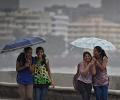
The monsoon has finally brought back smiles to the faces of people, especially farmers, of India.

The Reserve Bank on Friday retained the inflation forecast for 2023-24 at 5.4 per cent, and vowed to take timely measures to prevent any spillovers of global food and fuel price shocks. Stressing that the Reserve Bank has identified high inflation as a major risk to macroeconomic stability and sustainable growth, Governor Shaktikanta Das said the September retail inflation number may be lower than August and July prints. The headline inflation based on Consumer Price Index (CPI) moderated to 4.6 per cent in first quarter of 2023-24 as compared to 7.3 per cent in the same period a year ago.
Gold purchases have risen after the Reserve Bank of India (RBI) and the government lifted the restrictions imposed on imports in 2013.

Global trends and trading activity of foreign investors would largely dictate terms in the equity markets this week amid a lack of major domestic triggers, analysts said. Markets may face near-term consolidation due to elevated valuations, they noted. "While the previous week was predominantly shaped by developments in the US Federal Reserve policy, attention will now shift to the Bank of Japan's policy decision on December 19," Santosh Meena, Head of Research, Swastika Investmart Ltd, said.
With El Nino emerging, forecasts rainfall at 95% of long-period average.
As the kharif sowing season exceeds two months, no crop has managed to reach the normal area of cultivation (average of the past five years), except for sugarcane, cotton and jute.
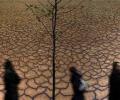
India will be able to manage potential inflationary pressures if forecasts of sub-par monsoon
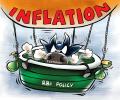
The Reserve Bank of India on Thursday marginally lowered its inflation projection for the current financial year to 5.1 per cent, as Governor Shaktikanta Das said the central bank's monetary policy actions are yielding the desired results. In April, the Reserve Bank had estimated the consumer price index (CPI) based retail inflation at 5.2 per cent during the fiscal 2023-24. CPI inflation fell sharply to 4.7 per cent in April 2023, from 6.4 per cent in February, on the back of favourable base effects, with softening observed across all the three major groups.

On the back of sound macroeconomic policies and softer commodity prices, India's growth momentum is likely to be sustained in 2023-24 in an atmosphere of easing inflationary pressures, said the Reserve Bank's annual report released on Tuesday. It, however, added that slowing global growth, protracted geopolitical tensions and a possible upsurge in financial market volatility following new stress events in the global financial system could pose downside risks to growth. "On the back of sound macroeconomic policies, softer commodity prices, a robust financial sector, a healthy corporate sector, continued fiscal policy thrust on quality of government expenditure, and new growth opportunities stemming from global realignment of supply chains, India's growth momentum is likely to be sustained in 2023-24 in an atmosphere of easing inflationary pressures," it said.

India experienced its second-hottest quarter from June to August this year since 1970, with over one-third of the country's population enduring at least seven days of dangerous heat, according to a new report by a United States-based group of climate scientists and communicators.

India staring at first drought in six years.

'There is no mechanism to understand how things would evolve'.

Prime Minister Modi last week called for optimal grain storage, fire audits and mock drills in hospitals as preparations for the harsh summer forecast by the meteorological department.

While weather forecasters remain divided on how the monsoons will play out in India over the next few months, analysts believe the news at the current juncture - at best - can trigger a knee-jerk reaction in the markets. They believe it is too early to say whether the sub-par monsoon on account of El Nino can seriously dent the market sentiment in the short-to-medium term. "These are just initial forecasts and we will have another round / status update from the weather forecasters a month down the line.

The heat wave is likely to impact parts of Jammu and Kashmir, Himachal Pradesh, Uttarakhand, Punjab, Haryana, Delhi, Rajasthan, Madhya Pradesh, Jharkhand, Odisha and Gangetic West Bengal, the Met office said.

India is likely to clock a GDP growth of 5.5 per cent during the current financial year provided there is normal monsoon and stable government at the centre, says a D&B report.

A below-normal monsoon can bring down India's GDP growth by 0.50-0.75 per cent this financial year, forcing the Reserve Bank to delay rate cuts to 2015, Bank of America-Merrill Lynch (BofA-ML) said.

The IMD defines a normal monsoon as one which delivers between 96 and 104 per cent of the 50-year average rainfall for the season.
Most climate models indicate that surface air temperature will increase with rise in green house gases over the Indian region, which would be accompanied by an increase in monsoon activity.

'We are not saying we are going to face a drought... We are a doing and performing government. A contingency plan is being prepared,' Science Minister Dr Harsh Vardhan tells Rediff.com

'It affects our economy, it is very important in many ways.' 'So we have to be the foremost experts in the world on the monsoon.' 'But the best minds in India have not devoted their time to the study of monsoon and they have followed the fashions of the West.'

According to Skymet Weather, the initial surge in the Monsoon rains can be attributed to the transition of El Nino into the neutral phase.

Fitch Ratings on Thursday retained India's growth forecast for the current fiscal at 6.3 per cent citing economic resilience despite tighter monetary policy and exports weakness, but upped year-end inflation projection on El Nino threat. The Indian economy grew 7.8 per cent in the April-June quarter of current fiscal on strong services sector activity and robust demand. "The Indian economy continues to show resilience despite tighter monetary policy and weakness in exports, with growth outpacing other countries in the region," Fitch said, while projecting 6.3 per cent growth for current fiscal (April-March), and 6.5 per cent for next fiscal.

'In FY23, PV sales are expected to end the year at a record 3.8 million units, up 26 per cent. In FY24, however, the industry is expecting 5-7 per cent volume growth'

While it hit the national capital two days before schedule, its entry into the financial capital is two weeks late, the Met office said.
.jpg)
The agency has kept its FY15 growth forecast unchanged at 5.6 per cent.

Improved monsoon, solid fiscal performance, and capex push by the public and private sectors augurs well for India's macroeconomic stability and growth, the finance ministry's monthly economic review for June 2023 said. But the report said that while India's domestic fundamentals remain strong, negative cross-border spillovers and adverse global developments could act as a deterrent in achieving the high growth path this financial year. "An improved matching of aggregate supply and aggregate demand in the Indian economy underpins the progress made in the control of domestic inflation and the consequent strengthening of macroeconomic stability," the review said.

The news will augur well for the country as large parts have been witnessing agriculture distress and water levels in reservoirs in west and south India have dipped to low levels.

The graphic above shows the number of heat wave deaths in India each year since 1967.

Prices of perishable items could spike in the near term.
